


Yukon blog
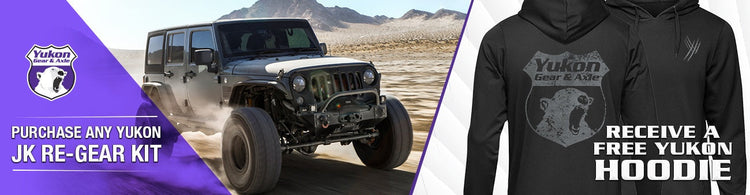
Wholesale Deal on JK Gear Kits
4.11 RATIO (YGK055) NON-RUBICON 4.11 ratio. Fits 2007 and newer Jeep JK NON Rubicon. Includes front and rear Ring & Pinions and Yukon Master install kits. More Info 4.56 RATIO (YGK012) NON-RUBICON Yukon gear packages provide an easy way to re-gear a four wheel drive vehicle with one simple part number. 4.56 ratio. Fits Jeep non-Rubicon JK. Includes front and rear ring & pinion sets and Yukon Master Overhaul Kits. More Info 4.88 RATIO (YGK013) NON-RUBICON Yukon gear packages provide an easy way to re-gear a four wheel drive vehicle with one simple part number. 4.88 ratio. Fits Jeep non-Rubicon JK. Includes front and rear ring & pinion sets and Yukon Master Overhaul Kits. Technical Notes: If you are running a 3.21 ratio you will need to purchase a new front carrier case with this package. More Info 5.13 RATIO (YGK014) NON-RUBICON Yukon gear packages provide an easy way to re-gear a four wheel drive vehicle with one simple part number. 5.13 ratio. Fits Jeep non-Rubicon JK. Includes front and rear ring & pinion sets and Yukon Master Overhaul Kits. Technical Notes: If you are running a 3.21 ratio you will need to purchase a new front carrier case with this package. More Info 4.11 RATIO RUBICON (YGK056) 4.11 ratio. Fits Jeep Rubicon JK. Includes front and rear ring & pinion sets and Yukon Master Overhaul Kits. More Info 4.88 RATIO RUBICON (YGK015) Yukon gear packages provide an easy way to re-gear a four wheel drive vehicle with one simple part number. 4.88 ratio. Fits Jeep Rubicon JK. Includes front and rear ring & pinion sets and Yukon Master Overhaul Kits. More Info 4.56 RATIO RUBICON (YGK054) 4.56 ratio. Fits 2007 and newer Jeep JK Rubicon. Includes front and rear Ring & Pinions and Yukon Master Overhaul Kits. More Info 5.13 RATIO RUBICON (YGK016) 5.13 ratio. Fits Jeep Rubicon JK. Includes front and rear ring & pinion sets and Yukon Master Overhaul Kits. More Info 5.38 RATIO RUBICON (YGK017) 5.38 ratio. Fits Jeep Rubicon JK. Includes front and rear ring & pinion sets and Yukon Master Overhaul Kits. More Info
Yukon Advantage
THE YUKON ADVANTAGE Yukon Gear & Axle is renowned for offering the highest quality aftermarket differential and drivetrain parts. Using precision engineering, high-strength performance steels, and tolerances that meet or exceed OE grade, Yukon manufactures the widest selection including ring & pinions, limited slips, lockers, axles, rebuild kits, hubs, driveshafts, and more! Builders, performance shops, and enthusiasts that demand quality parts for installation, racing, and performance modifications use Yukon parts. QUALITY Step up to the quality of Yukon Gear & Axle. Engineered in our Everett, Washington headquarters, Yukon uses state-of-the-art design, manufacturing, and testing processes, backed by two in-house quality labs to ensure every item meets exact specifications and quality standards. WIDE SELECTION With over 4,000 part numbers, our parts span everything from diesel trucks, high performance, rock crawlers, circle track, street racing, and general performance to name a few. Our parts are developed for most domestic and select import vehicles with a differential. HIGH FILL RATE + FAST SHIPPING Yukon Gear & Axle boasts an incredibly strong distribution network throughout the US with ties throughout the world. In addition, Yukon has seven fully stocked warehouses with 1–2 day shipping nationwide. Two-day shipping covers 95% of the USA. SERVICE Yukon Gear & Axle knows what it takes to keep our products on the streets. Great customer service, impeccable part quality, and technical knowledge ensure that the parts customers purchase are backed with industry-leading warranties and technical support. Spin Free Kits UNBOXING THE YUKON SPIN FREE KIT YUKON SPIN FREE KITS Yukon’s top of the line Hub conversion kit uncouples your wheels from the front axle, reducing drag for a smoother ride and boosting fuel economy. Replace worn and vulnerable factory unit bearings with our complete Yukon Spin Free kit, including 4340 Chromoly Steel axles and forged hubs on most applications. Includes Yukon Hardcore Locking Hubs to engage 4WD and disengage easily for road use. Find Spin Free Kits Now Grizzly Lockers YUKON GRIZZLY LOCKER Providing maximum traction and strength for many performance applications, Grizzly Lockers are available for a variety of car & truck applications. Proudly assembled in the USA. YUKON GRIZZLY LOCKERS Heat-treated 8620 & 9310 steel internals designed to dominate extreme torque and shock load. Large inner-clutch teeth are 350% stronger than back-cut designs. Premium alloy steel and nodular iron cases provide performance-quality strength with minimal deflection. Find Grizzly Lockers Now Front Axle Kits YUKON AXLE KITS Yukon Front Axles provide next-level strength and toughness from 100% 4340 Steel, undergo proprietary heat treatment, and in-house torque testing. Tight tolerance yoke-ends prevent vibration, and smooth bearing journals maximize bearing and seal life. YUKON FRONT AXLE KITS 4340 Steel with proprietary heat treatment and in-house torque testing. Tight tolerance yoke-end ensures proper u-joint fit. Precision bearing journals maximize bearing and seal life. Find Front Axle Kits Dura Grips YUKON DURA GRIP YUKON DURA GRIP Quick reaction to all traction situations. 4320 Steel Bevel Gears handle high torque and shock loads. Heavy springs and precision bevel gears optimize clutch pack engagement. Heavy-duty nodular iron case outperforms OE cases by 20–30%. Find Your Dura Grip Now Zip Lockers YUKON ZIP LOCKER The Zip Locker is an air-operated locking differential designed for severe off-road use. Forged case and 4320 steel internals provide maximum strength. Each unit includes all necessary installation parts. Competition series units default to lock if air pressure is interrupted. YUKON ZIP LOCKERS - AIR OPERATED LOCKER Forged steel case protects internals with minimal deflection. Air-operated locker; compact air compressor sold separately. Handles extreme torque and shock loads with heat-treated 4320 & 9310 steel gears. Bevel gears optimized with specialized software for superior strength. Find Zip Lockers Now Ring & Pinion Gear Sets HOW TO IDENTIFY RING & PINION GEAR RATIO | DIFFERENTIAL TECH TIPS Learn how to quickly identify the appropriate ring & pinion gear ratio for your vehicle. YUKON RING & PINIONS Rigorous quality standards with in-house QA Lab testing and Gleason CAGE design software. High torque load capacity and low noise output. Enhanced gear pattern for easier installation. Find Ring & Pinion Gear Sets Rear Axle Shafts HOW TO IDENTIFY YOUR DIFFERENTIAL & AXLE TYPE | DIFFERENTIAL TECH TIPS Quick tips on identifying common differential types and axle styles. YUKON REAR AXLE SHAFTS High-strength 1541H Steel with heat-treated bearing journals for longer life. Smooth bearing journals maximize bearing and seal life. Precision-controlled c-clip buttons ensure proper fit and reduced endfloat. Find Rear Axle Shafts Master Overhaul Kits YUKON MASTER OVERHAUL KITS Most complete Master Overhaul Kits in the industry. Premium grade fasteners and high-quality Yukon Mighty Seals. Thoughtfully engineered shim stacks and super shims for precise adjustments. Technical support readily available throughout installation. Find Master Overhaul Kits Y.E.S. Plan Lifetime Warranty YUKON EXTENDED SERVICE (Y.E.S.) PLAN Get the Yukon Extended Service (Y.E.S.) Plan to warranty your Yukon products for life. Coverage includes: 3rd Members, Front & Rear Axles, Zip Lockers, Performance Driveshafts, Grizzly Lockers, Dura Grips, and Ring & Pinion Sets. Get a YES Plan now
TS/JL
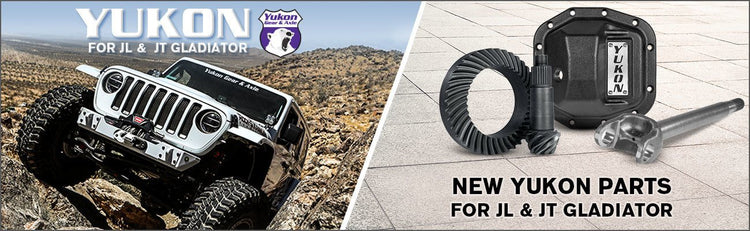
They're Here: Jeep Wrangler JL Parts and Gladiator JT Gears NOW AVAILABLE: Yukon performance parts for Jeep JL. Plus, new gears for the hot 2020 Jeep Gladiator JT! #RANDYSWorldwide #YukonGearandAxle Available JL Gear Ratios: 3.45 | 3.73 | 4.11 | 4.56 | 4.88 | 5.13 | 5.38 Yukon JL parts fit Dana 30 or Dana 44 Fronts and Dana 35 or Dana 44 Rears. These Ring & Pinions are designed for easier installation through enhanced quality engineering. Yukon Gears get you unmatched torque load capacity and offer quiet operation and simple setup. Gain confidence knowing your bearings are held to Timken’s fitting best practices and won’t slip or crack under pressure. Yukon Gears are held to rigorous quality and engineering standards with in-house QA Lab testing and Gleason CAGE design software so you get the best product available on the market. Shop JL Parts Shop TJ Parts Yukon Performance Driveshaft for Jeep Wrangler JL OE Replacement JL Driveshafts: Yukon OE Replacement Driveshafts are made with high strength, serviceable 1310 U-Joints. Works for stock height to 2.5” lift and 33" tires. Includes replacement transfer case yokes. Heavy Duty 1310 JL Driveshafts: Upgraded with 1350 Universal Joints. Supports 4.5" suspension lift and 35" tires. Includes transfer case yoke, 1310 u-bolts, u-joints, 2"x.120" tubing and grade 8 hardware. Heavy Duty 1350 JL Driveshafts: Top-of-the-line heavy duty 1350 Universal Joints. Supports 4.5" lift and up to 37" tires. Includes new transfer case yoke for OE flange. Heavy Duty 1410 Driveshafts: Fully splined 1.5" stub, solid 1410 u-joints, and 2.125"x.188 tubing. Custom built to vehicle specifications. Yukon Master Overhaul Kit for Jeep Wrangler JL Yukon Gear & Axle offers the most complete Master Overhaul Kits available. Thoughtfully engineered shim stacks and super shims allow for precise adjustments. Premium grade fasteners and high-quality Yukon Mighty Seals are included in most kits. Each kit uses Timken bearings and races, high-quality seals, carrier bearings and races, pinion bearings and races, pinion seal, complete shim kit, ring gear bolts, pinion nut, crush sleeve (if applicable), oil baffles and slingers (if applicable), thread locking compound, marking compound with brush, and gasket. Yukon Ring & Pinions for Jeep Gladiator JT Yukon now offers Ring & Pinions in a variety of ratios for the 2020 Gladiator. Plan your lift and tire upgrade with the appropriate gear ratio from Yukon Gear & Axle. Yukon Gears provide unmatched torque load capacity and quiet operation through precise engineering. Bearings follow Timken’s best practices and won’t slip or crack under pressure. Yukon Gears are held to rigorous quality standards with in-house QA Lab testing and Gleason CAGE design software. Available Now: Yukon Performance Axles and Hardcore Differential Covers for Jeep Wrangler JL Yukon Rear Axles: High-strength 1541H steel axles with heat treated bearing journals for longer life and less c-clip wear. Precision c-clip buttons ensure proper fit. Yukon Front Axles: 100% 4340 steel with heat treatment and torque testing. Tight tolerance yoke-end ensures u-joint stability. Smooth bearing journals maximize bearing and seal life. Yukon Hardcore Diff Covers: Thick-walled nodular steel for extreme impacts. Protects lockers, gears, and axles. Includes powder coat finish, magnetic drain plug, gasket, and high-strength fasteners. Find JL Parts Find TJ Parts
Yukon Spring Into Summer Rebate 2019
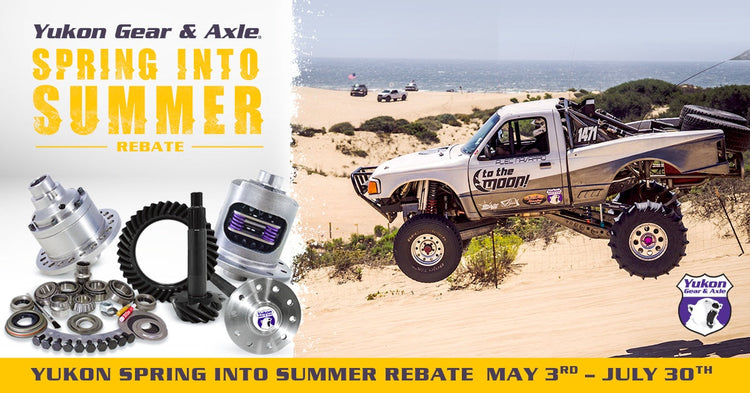
Spring into Summer 2019 Yukon Rebate Program Scroll down to see HOT deals and watch unboxing videos. Yukon Spin Free Kits - $150 Rebate Yukon’s top of the line Hub conversion kit uncouples your wheels from the front axle, letting it operate more efficiently, reducing drag for a smoother ride and boosting fuel economy Replace your inaccessible, worn and vulnerable factory unit bearings with our complete Yukon Spin Free kit that comes with our toughest outer axles forged from 4340 Chromoly Steel, and forged hubs on most applications. Clean and sleek, this kit includes Yukon Hardcore Locking Hubs that let you engage into 4WD to play hard and easily disengage for the road back home. More Info Find Spin Free Kits Now Yukon Grizzly Locker - Save $55 Tear it up with our Grizzly Locker’s heat treated 8620 & 9310 Steel internals designed to dominate extreme torque and shock load Large inner-clutch teeth are stronger than back-cut designs by 350%, allowing great resistance to shock load or broken axle failures Premium alloy steel and nodular iron cases are designed for performance quality strength with minimal deflection More Info Find Grizzly Lockers Now Yukon Front Axle Kits - $50 Rebate Next-level strength and toughness from 100% 4340 Steel that undergoes Yukon’s stringent proprietary heat treatment process and in-house torque testing Tight tolerance yoke-end is the trick to a properly fitted u-joint that won’t vibrate or loosen Smooth and precise bearing journals are the secret to maximizing bearing and seal life, thanks to Yukon’s unique surface finishing treatment More Info Find Front Axle Kits Yukon Dura Grip - $40 Rebate Versatile performance allows quick reaction to all traction situations Ready to handle high torque and shock loads with the use of 4320 Steel Bevel Gears, which are up to 50% stronger than OE materials The heavy springs used in the Dura Grip provide ideal traction under light load, while the precision bevel gears further compress the composite clutch packs under heavy loads for best lock up Exceptionally heavy-duty nodular iron case will outperform OE iron cases by 20-30% More Info Find Your Dura Grip Now Yukon Zip Lockers - FREE Air Compressor Yukon’s most impressive locker yet, forged from an entirely steel case to protect the internals with minimal deflection and maximum strength Air operated intelligently designed locker, compact air compressor sold separately Designed to handle extreme torque and shocks loads, heat treated 4320 & 9310 steel bevel gears and lock ring let you unleash power and stay locked until you disengage the locker Bevel gears are optimized using our specialized design software to create a stress balanced tooth design that promotes superior strength and eliminates weak links More Info Find Zip Lockers Now Yukon Ring & Pinion Gear Sets - $25 Rebate Yukon Gears are held to rigorous quality and engineering standards with in-house QA Lab testing and Gleason CAGE design software Re-gear this summer and get unmatched torque load capacity and low noise output thanks to our precisely controlled transverse contact ratio Gain confidence knowing your bearings are held to Timken’s fitting best practices and won’t slip or crack under pressure Designed to ease installation through enhanced gear pattern length, width, and location More Info Find Ring & Pinion Gear Sets Yukon Rear Axle Shafts - $20 Rebate High-strength 1541H Steel lets us intensely heat treat our bearing journals for longer life and less wear on c-clip applications Smooth and precise bearing journals are the secret to maximizing bearing and seal life, thanks to Yukon’s unique surface finishing treatment Say goodbye to excessive endfloat with Yukon’s precision controlled c-clip buttons that provide proper fit every time More Info Find Rear Axle Shafts Yukon Master Overhaul Kits - $20 Rebate Most complete Master Overhaul Kits available in the industry Premium grade fasteners and high quality Yukon Mighty Seals in most kits Thoughtfully engineered shim stacks and super shims allow for precise adjustments Technical expertise readily available to offer support throughout installation one call away More Info Find Master Overhaul Kits

Yukon 2019 Spring Rebate
Spring into Summer 2019 Yukon Rebate Program Scroll down to see HOT deals and watch unboxing videos. Yukon Spin Free Kits - $150 Rebate Yukon’s top of the line Hub conversion kit uncouples your wheels from the front axle, letting it operate more efficiently, reducing drag for a smoother ride and boosting fuel economy Replace your inaccessible, worn and vulnerable factory unit bearings with our complete Yukon Spin Free kit that comes with our toughest outer axles forged from 4340 Chromoly Steel, and forged hubs on most applications. Clean and sleek, this kit includes Yukon Hardcore Locking Hubs that let you engage into 4WD to play hard and easily disengage for the road back home. More Info Find Spin Free Kits Now Yukon Grizzly Locker - Save $55 Tear it up with our Grizzly Locker’s heat treated 8620 & 9310 Steel internals designed to dominate extreme torque and shock load Large inner-clutch teeth are stronger than back-cut designs by 350%, allowing great resistance to shock load or broken axle failures Premium alloy steel and nodular iron cases are designed for performance quality strength with minimal deflection More Info Find Grizzly Lockers Now Yukon Front Axle Kits - $50 Rebate Next-level strength and toughness from 100% 4340 Steel that undergoes Yukon’s stringent proprietary heat treatment process and in-house torque testing Tight tolerance yoke-end is the trick to a properly fitted u-joint that won’t vibrate or loosen Smooth and precise bearing journals are the secret to maximizing bearing and seal life, thanks to Yukon’s unique surface finishing treatment More Info Find Front Axle Kits Yukon Dura Grip - $40 Rebate Versatile performance allows quick reaction to all traction situations Ready to handle high torque and shock loads with the use of 4320 Steel Bevel Gears, which are up to 50% stronger than OE materials The heavy springs used in the Dura Grip provide ideal traction under light load, while the precision bevel gears further compress the composite clutch packs under heavy loads for best lock up Exceptionally heavy-duty nodular iron case will outperform OE iron cases by 20-30% More Info Find Your Dura Grip Now