


Yukon blog

Yukon Soap Box Derby Racer
The Soap Box Derby: An All-American Tradition The Soap Box Derby is an all-American pastime with a storied past that stretches back to 1934. Aspiring racers compete in local derbies to qualify for the big race in Akron, Ohio. The road that led to the Yukon car can be traced back to 2007 and RANDYS Worldwide salesman Tate Hudson was the flashpoint. Getting Involved in the Stanwood-Camano Soap Box Derby “We have been a part of the Stanwood-Camano Soap Box Derby since 2007,” says Tate. “My son Sam, who was a fourth grader at the time, was picked out of his scout group to race their car. From the first time he went down the hill, he was hooked. Marla and Randy Heagle with Stanwood-Camano Windermere have been hosting this community event since 2006. During those days, we collected donations from the community and purchased our own car with the proceeds to race a Warm Beach Community-sponsored car, which Sam raced until he got too old for it.” The Yukon Special “Fast forward to 2018 when my daughter Sophie decided she wanted to race in the Soap Box Derby, we realized that since it had become such a huge event with many local sponsors getting involved, it would be a great idea for Yukon to sponsor a car. I pitched the idea to Neal Hollingsworth in our marketing department and he was enthusiastically on board immediately. We had a local shop in Sedro Wooley wrap the car in the same style graphics as the dragster we sponsor and it turned out great! For kids that can’t afford their own cars Randy and Marla have a lottery system for loaner cars and the Yukon car is driven each year by a less fortunate young boy or girl who gets to experience building the car from the ground up with their parents or guardians.” Yes, the ‘Yukon Special’ is dismantled after each season, waiting for the next hopeful racer to enter its life. Soap Box Derby events are open to competitors age seven to 20. Our car is part of the Stanwood-Camano Soap Box Derby, which consists of two races per year: the Stanwood-Camano Soap Box Derby on Father’s Day weekend and the Summer Classic Rally Races in mid-August. But the Soap Box experience begins well before the green flag flies. Learning STEM Through Racing Racers are teamed with a mentor who helps them construct the car. Typically, the cars are built from kits, but interested parties like Yukon sponsor the car for those who can’t afford their own kit. Participants work with mentors and learn STEM skills (Science, Technology, Engineering, and Math), collaboration, and how to handle tools as they construct their cars at dedicated Build Clinics in the months leading up to a race. Racing Divisions There are three racing divisions: Stock Division: Entry level for children ages 7–13, using simplified lean-forward style cars with a max weight of 200 pounds. Super Stock Division: For ages 9–17 with more advanced cars, max weight 240 pounds. Master’s Division: For ages 10–19, featuring sophisticated cars built from Scottie Masters kits with four-piece fiberglass bodies and advanced wheels. Our car is a Stock class car and Randy says it’s one of 75 racers in his stable of sponsored cars. “The kids and the parents really love the Yukon car,” says Randy. “It’s very cool looking and it pops… it might be the only car with purple on it as well.” Keys to Winning The biggest difference makers of any Soap Box racer are precision of assembly, design and placement of weights within the car, wheel alignment, and steering cable tension. Randy points to the cockpit as well. “The cars all weigh the same with a driver in them, the wheels and lanes are swapped for every round at all the races. Sure, there’s some amount of fine tuning… but the drivers are difference makers too. Staying super low and tucked in the cockpit and driving the natural slopes down the track are often the keys to winning.” Big Events and Community Impact Events at Arrowhead Ranch can attract up to 1,500 spectators. The recent 14th Annual Windermere Stanwood-Camano Soap Box Derby, held the Saturday before Father’s Day 2021, was the biggest race ever this side of the Mississippi River. The track at Arrowhead Ranch is 800 feet long and the cars can reach speeds in excess of 30 mph. Racers accumulate points that can earn them a trip to Akron, Ohio for the World Championships at Derby Downs. “How can you not take advantage of keeping youth involved in the sport that so many of us in motorsports participated in,” said Neal Hollingsworth, Yukon’s VP of Marketing. “They feel like a part of something big and learn great skills along the way. As community outreach is so important today, this was a no-brainer for Yukon to get behind and support so less fortunate kids have a platform to build and drive a branded race car.” Click here for more info on the Stanwood-Camano Soap Box Derby.
Choosing The Right Gear Ratio - Video
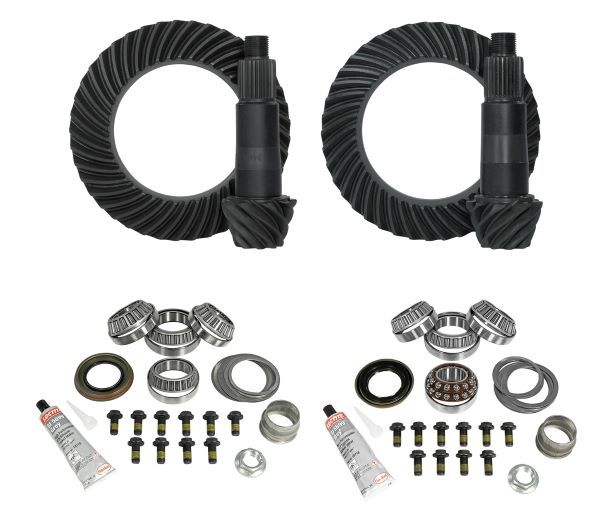
There are three main reasons to re-gear your ride. The first is to recapture the lost drivability and fuel efficiency of a daily driven vehicle that has been upgraded with larger wheels and tires. The second is to fine tune the performance characteristics of a vehicle that is a dedicated off-roader, tow rig, or drag racer where the focus is more on low-end grunt and acceleration. The third is to improve fuel efficiency. The accompanying video outlines the reasoning and consid3rations that should go into finding the right gear ratio for your ride. Shop Re-Gear Kits

Chromoly: The Science Behind Yukon Performance Axles
Chromoly… the utterance of the word conjures images of superhero strength. The word is derived from chromium and molybdenum, the two main alloying elements of the metal. Chromium brings three major benefits to the table: innate hardness, improved pliability during the quenching process, and outstanding corrosion resistance. Molybdenum also serves to increase the alloy’s hardness. Read this article in Español When it comes to performance axles the use of chromoly results in axles that can handle the added stress that comes with running larger tires, adding aggressive traction devices, and other parameters like how aggressively you approach off-roading. Their superior resistance against breakage, distortion, and corrosion mean more peace of mind on the trail or the track. Yukon uses 4340, a high-quality nickel-chromium-molybdenum alloy in the manufacturing of forged gears, pinion gears, high-performance axles, Super Joints, and more. Machining A Yukon Axle Shaft The majority of machining on an axle shaft is done prior to heat-treating, but some applications have machine work that is done post heat-treat. Typical machining procedures include grinding/polishing bearing or seal surfaces, forming flanges and wheel pilots, drilling stud holes, milling ears for full circle clips, boring u-joint holes, balancing etc. Spline creation is the most important machining processes in axle creation. This is a “there are many ways to skin a cat’ scenario. The cutting method which includes spline milling, rotary broaching, bobbing machines, and disc cutting is one part of the equation. Then there’s the spline rolling method which uses CNC machinery to form the splines by the displacement of metal, not the removal of metal as found in cutting processes. Yukon machines its splines by cold roll forming on almost all of its axle applications. Akin to the principles of forging, the axle shaft is subjected to a great deal of pressure via tooling in the machine that contains the splines, both the shape and number determined by the design specs. In only a few revolutions the cam-like tooling dies imprints the shaft with splines. This is the best, most high-tech way to make splines and the advantages of this process are many. The high pressure involved in creating the splines re-arranges the grain structure of the metal throughout the entire tooth profile. This ensures consistent hardness throughout the spline teeth and shaft. Further, the magic happens at room temperature so the final product maintains its tensile strength and hardness, has greater yield, and the process produces superior surface finish versus methods that cut or extrude the splines. This level of attention to detail results in an axle that you can count on in the most trying terrain. Strength Of A Caped Crusader Stock axles are typically made of medium-carbon 1039, 1050, or 1055 alloys, and in some cases 1541 series steel that is forged and heat-treated or hardened. What to call this strengthening process comes down to semantics… it can be called either heat-treating or hardening because heat treating is the procedure and hardening is the result… think cause and effect. Chromoly is a dynamically stronger metal than 1000-series alloys and since one is starting with a superior alloy heat-treating it only improves the material. The goal is to alter the properties of the metal on a molecular level, producing a tighter grain structure that changes the hardness, strength, toughness, ductility, and elasticity of the material in a beneficial way. Types of Hardening/Heat Treating There are two general types of hardening: case hardening and thru hardening. Case hardening only treats the surface layer while thru hardening penetrates to the center of the material. Thru hardening takes place in a furnace where the intense heat has the time to work into the core of the metal. There are a number of methods for case hardening which is the most popular heat-treating technique for stock and performance axles. Induction Hardening This type of hardening has been popularized by OE manufacturers. Induction hardening is fast, economical, effective, and controllable. Speed comes by not having to heat the entire component to its core. With the speed comes an economy of scale as more axles can be treated in a given timeframe, therefore lowering the overall treatment cost per axle. Effectiveness is the production of a part with a surface that is resistant to wear but maintains the toughness and strength of its core. Controllable in that the process can be used to selectively harden areas of a component without affecting the properties of the entire piece. For instance, some original equipment axles are only induction hardened up to the bearing mount surface near the flange. Induction hardening is the method Yukon uses on its entire line of performance axles. The process starts with an axle shaft that has likely been fully machined with splines etc. The shaft is heated with an induction coil to a predetermined temperature usually between 1,550- and 1,600-degrees Fahrenheit then quenched. Quenching is basically dousing the part with water or dropping it in an oil bath to quickly cool it. Yukon’s quality assurance staff tests axles from random production batches to ensure they receive proper heat treating and measure up dimensionally to engineering blueprints. Carburizing Carburizing is somewhat similar to induction hardening but it changes/improves the mechanical properties of the material by introducing a new component. Induction coils, or other heating elements, bring the metal to a high temperature. The steel substrate is then exposed to an external source of carbon (gas, liquid, or solid) to form carbides on the surface of the steel. The material is then quenched to seal the deal. Nitride Hardening Nitriding is a play on the carburizing method except nitrogen carrying substances (ammonia) are infused into the substrate instead of carbon. The surface coating process results in the formation of nitrides on the steel substrate. This particular case hardening process is chromoly specific because nitrides can only be created on metals that contain the elements chromium and molybdenum. Nitride hardening differs from other case hardening techniques in that lower temperatures are used in heating and the quenching step is skipped altogether. This can be beneficial because less heat and less quenching shock produces less distortion in the final product. Yukon does not employ this process because the nitride infused surface does not benefit axle performance, the process is expensive, and it takes longer. Tempering Tempering refers to repeating a heat-treating process until a desired hardness is attained. The Benefits Of Hardening Axles The ultimate goal of heat-treating an axle is to create a hard, abrasion resistant outer microstructure while retaining the steel’s tensile strength within its core… bulletproofing if you will. The result is an axle shaft that can take a pounding, endure a great deal of friction wear, and also possess the torsional strength to absorb the twisting forces encountered in high-traction-demand situations. Need a caped crusader in your drivetrain? Getting serious in your off-roading, planning to run bigger tires, need to replace an axle and want the best?... Yukon goes the extra mile at every stage of chromoly axle development; design, manufacturing, and quality control so you get an axle that will absorb the most extreme off-road punishment for years to come. contact us at 866-631-0196 Shop Yukon Chromoly Axles

Proper Gear Break-In - Video
Gear break-in consists of controlled heat cycling of the gear set in a way that properly seasons or hardens the gear’s contact surfaces. It is a series of test drives. These critical first few miles of drive time can be the difference between a gear-melting headache and years of carefree driving. Failure to properly break-in your gear set can result in damaged, failing gears and a complete re-do. Once the wrenches have been laid down and the gears have been properly installed with backlash and preload correctly set there’s still more to do. The gear set must be broken in on urban roads and the freeway because different vehicle speed ranges produce different heat cycling. Towing is a whole other ball game. If you tow you’ll need an additional round of break-in because the physics of towing puts additional pressure on the pinion and slightly changes its position on the ring gear teeth… it’s like you’re hardening a new spot on the gear teeth. Check out the accompanying video for more specifics about proper gear break-in procedures.
How It Works: Spider Gears - Video
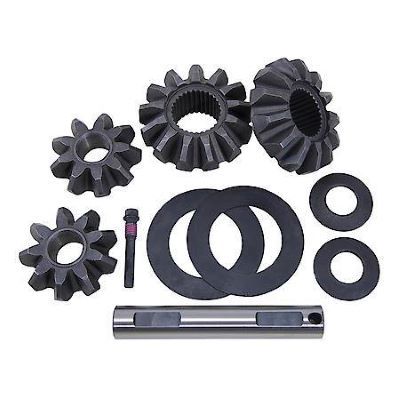
Spider gears are primetime players inside the differential. Also known as satellite gears, spider gears rotate around the side gears in the differential carrier. Side gears may also be referred to as axle gears or planetary gears. To spot spider gears look for the gears with the cross-pin shaft going through them. Read this article in Español What Gears Do The diff’s array of spider and side gears take the rotational energy from the driveshaft and help redirect it outwards to the axles and on to the tires. More importantly, they also play a key role in allowing the tires to rotate smoothly at different speeds when the vehicle is turning. Gears In Trouble Broken spider gears will make a grinding or banging sound when the vehicle is turning because the difference in wheel speeds causes the chatter. You usually won’t hear them when traveling in a straight line because the spider gears remain motionless within the carrier in this instance. But, if they are bad enough, compromised spider gears will make noise even when going straight. When you hear a loud differential think of metal flakes being formed and circulated throughout the unit, usually damaging the vulnerable bearings first. So, noise means trouble. In some cases, the damage may not be the gears themselves. When the spider gears are in motion they rotate on the cross-pin shaft, especially when the vehicle is turning a corner. But there are situations that can cause over spinning and the result can be a heat-scored cross-pin shaft. A common scenario is getting stuck in the mud or snow and free spinning your wheels trying to break free. When this happens, the spider gears can rotate on the cross-pin shaft so quickly that the differential oil is slung away, resulting in metal-on-metal wear. In extreme cases the cross-pin shaft and the gear get so hot that they melt each other, sometimes to the point where they weld themselves together. Damage such as this can not only damage the spider gear set, but also destroy the carrier and ring and pinion gear set. Spider Gear Replacement When replacing spider gears you are, in fact, replacing both the spider gears and the side gears. Over the miles these gears mesh and wear in unison, so dropping in new spider gears with the original side gears can cause an imbalance. Yukon Gear & Axle and USA Standard Gear spider gear kits include two side gears, two pinion gears, a cross pin shaft, a roll pin, and thrust washers. Installation is relatively straightforward. For a more in-depth look, view the accompanying installation video from our YouTube channel. contact us at 866-631-0196 Shop Spider Gear kits